
More than you ever wanted to know about pH sensor selection & care
We'll keep this short – well, sort of. pH sensors can be an involved subject, so here are the points that matter most.
Why pH measurement matters
Facilities that discharge wastewater – to a sewer, a river, a lake or the ocean – must meet the pH limits set by federal, state and local regulations. Missing those limits can bring fines at a minimum, and the cost of cleanup if the environment is harmed. Logging and reporting the pH at the plant discharge point is good practice, and is often required.
Where neutralization systems go wrong
Wastewater treatment is usually a cost to a plant rather than a source of revenue, so its equipment often gets less maintenance attention than the rest of the facility. A pH measurement that drifts or responds slowly leads to discharge that is out of specification and readings that can't be trusted. Operators then tend to override the dosing system by hand, and costly over-dosing of acid or caustic follows.
Most of these problems trace back to the pH sensor itself: the wrong electrode type for the stream, a poor mounting location, or missed maintenance. Choosing the right sensor and caring for it properly are what keep a neutralization system running without trouble.
Choosing a pH sensor
A pH probe is a consumable part. How long it lasts depends on the stream it sits in and how well it is looked after, so matching the sensor to the application pays off twice: reliable readings and longer probe life. Compare probes on these points:
- Junction type – single, double, differential or non-porous
- Materials of construction – the body material that will face your process
- Glass membrane shape – chosen for the process and the cleaning method
- Connection – BNC, DIN or an integral cable
- Refillable or sealed – whether the reference electrolyte (KCl) can be topped up
- Cost against expected life
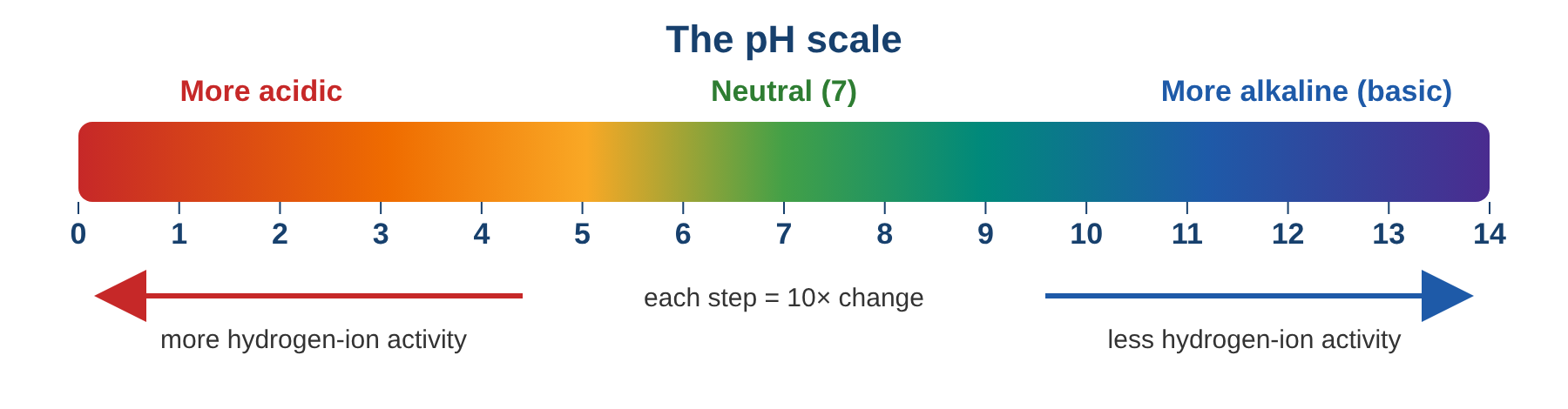
How a pH probe works
A pH probe measures how acidic or alkaline a liquid is – its hydrogen-ion activity – and reports it as a pH value.
The tip of the probe is a thin, pH-sensitive glass membrane. Where the glass touches the liquid, hydrogen ions trade places with ions in the outer layer of the glass; this ion exchange is the basic principle of the glass electrode. The same exchange happens on the inside surface of the glass, which faces the probe's own fill solution. When the hydrogen-ion activity inside and outside is different, a small voltage builds up across the glass. A reference electrode sitting in potassium chloride (KCl) electrolyte completes the circuit so that voltage can be measured.
The monitor reads the voltage and shows it as pH. The bigger the voltage, the bigger the difference in hydrogen-ion activity. More hydrogen-ion activity means a lower pH; less means a higher pH.
Calibrate a pH sensor before you use it and regularly after that. Frequent calibration and cleaning are the two habits that keep pH readings reliable.
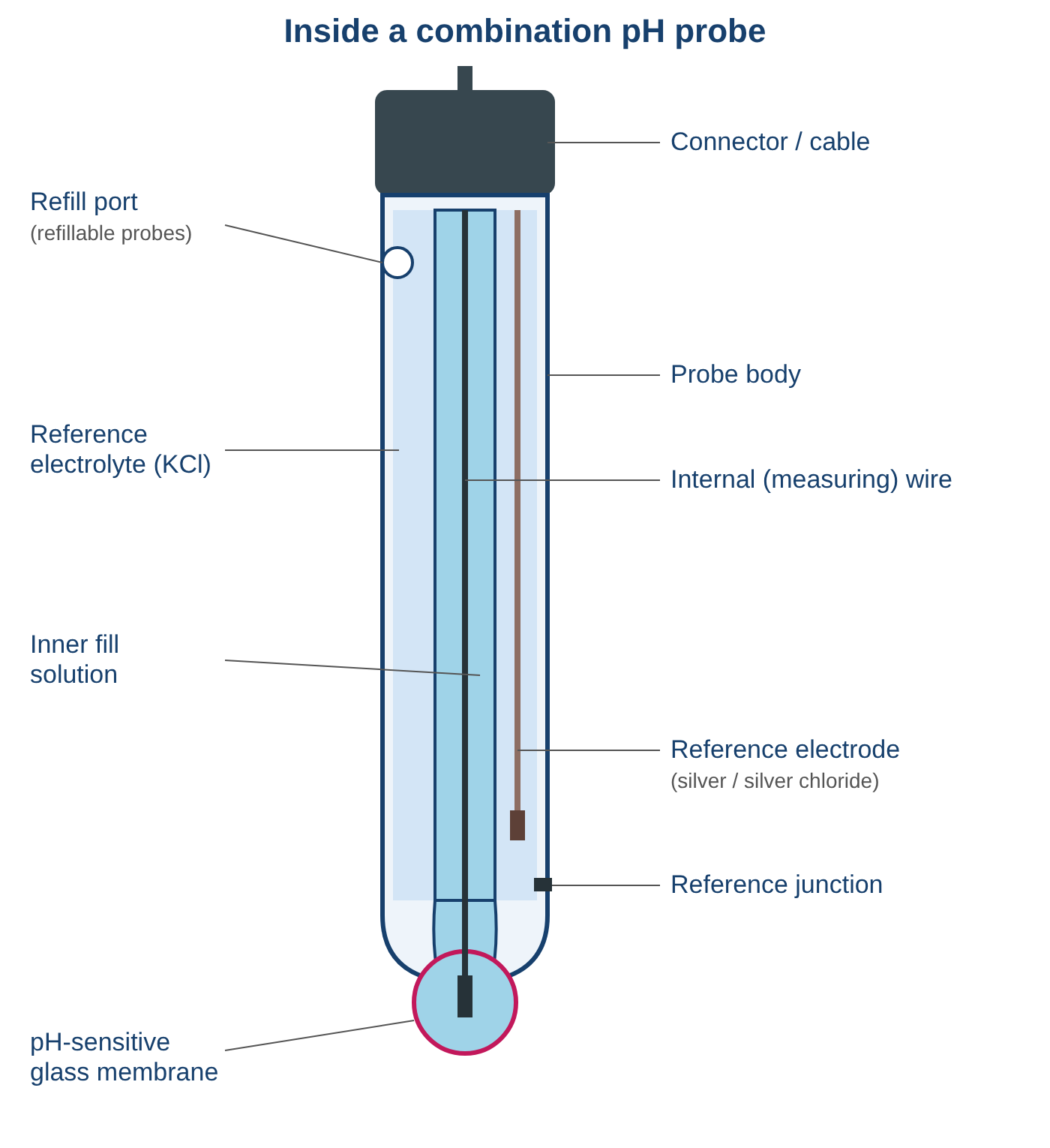
Probe parts and junction types
Every pH probe has the same main parts: the body, the pH-sensitive glass membrane, the reference electrode, the reference electrolyte, the reference junction, and a connector or cable. The biggest difference between probe types is the reference junction – the path that connects the reference electrolyte to the liquid being measured.
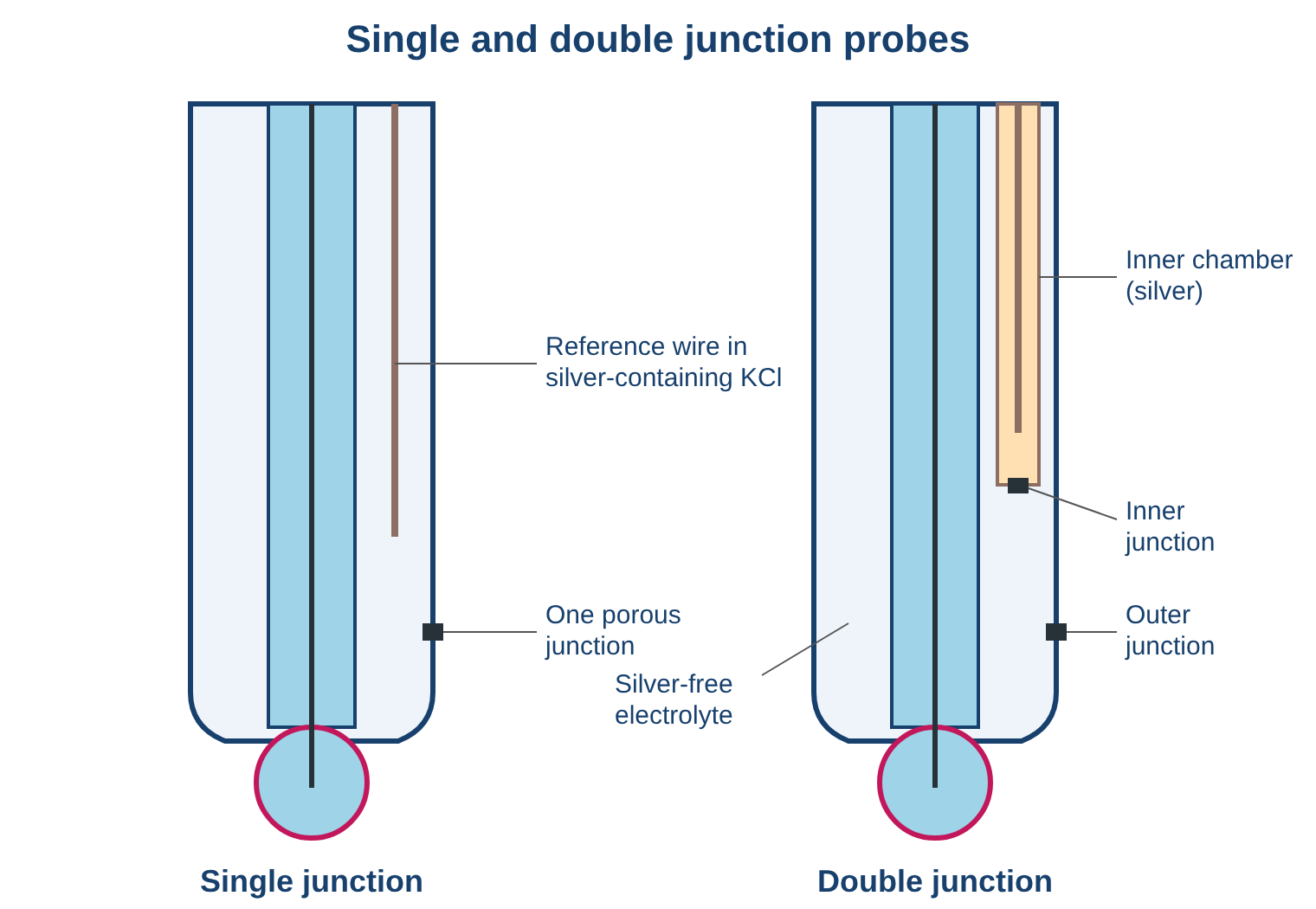
Single-junction probes combine the pH glass electrode with a silver/silver chloride (Ag/AgCl) reference in KCl, in one body, and come in many sizes. A porous junction lets the KCl touch the process liquid and complete the circuit. These probes wear out by design: the KCl slowly becomes diluted, and it can be poisoned when the liquid contains heavy metals, sulfides, proteins or anything else that reacts with silver. Dilution makes the reading drift; poisoning makes it wrong and eventually ruins the electrode. If the junction plugs, the probe can't measure at all. A slow, sluggish response is the warning sign of a plugging junction – and it can lead to costly over-dosing. Without regular maintenance, this type of probe soon gives unreliable readings.
Double-junction probes work the same way but have two porous junctions one after the other. They usually resist poisoning better and last longer than single-junction probes, but they still need frequent maintenance and calibration to stay accurate.
Differential probes were developed to stop poisoning of the Ag/AgCl reference. They use two glass electrodes: one touches the process liquid and the other sits in KCl inside the probe as the reference. Poisoning is reduced, but there is still a porous junction and the KCl still dilutes over time, so these probes also need maintenance.
Non-porous junction probes use the same pH glass as the others but have no porous reference junction, so the reference electrolyte can't be poisoned or diluted. In wastewater neutralization they last much longer than porous-junction probes and need very little maintenance – usually just periodic cleaning, which can be automated.
Materials of construction
Probe bodies are made in several materials, each suited to different conditions. List every contaminant of concern in your waste stream and check it against the material before you choose.
| Material | Where it fits |
|---|---|
| PVC | Low cost. Common applications where the liquid is not very aggressive; ambient to moderately warm temperatures. |
| CPVC | Low cost. Like PVC, but handles higher temperatures. |
| PEEK | Resists organics, solvents and gases. |
| PPSU (polyphenylsulfone) | For harsher thermal, chemical and mechanical conditions. |
| PPS (polyphenylene sulfide) | Very high chemical resistance. |
| 316 stainless steel | Where the probe could be physically damaged. |
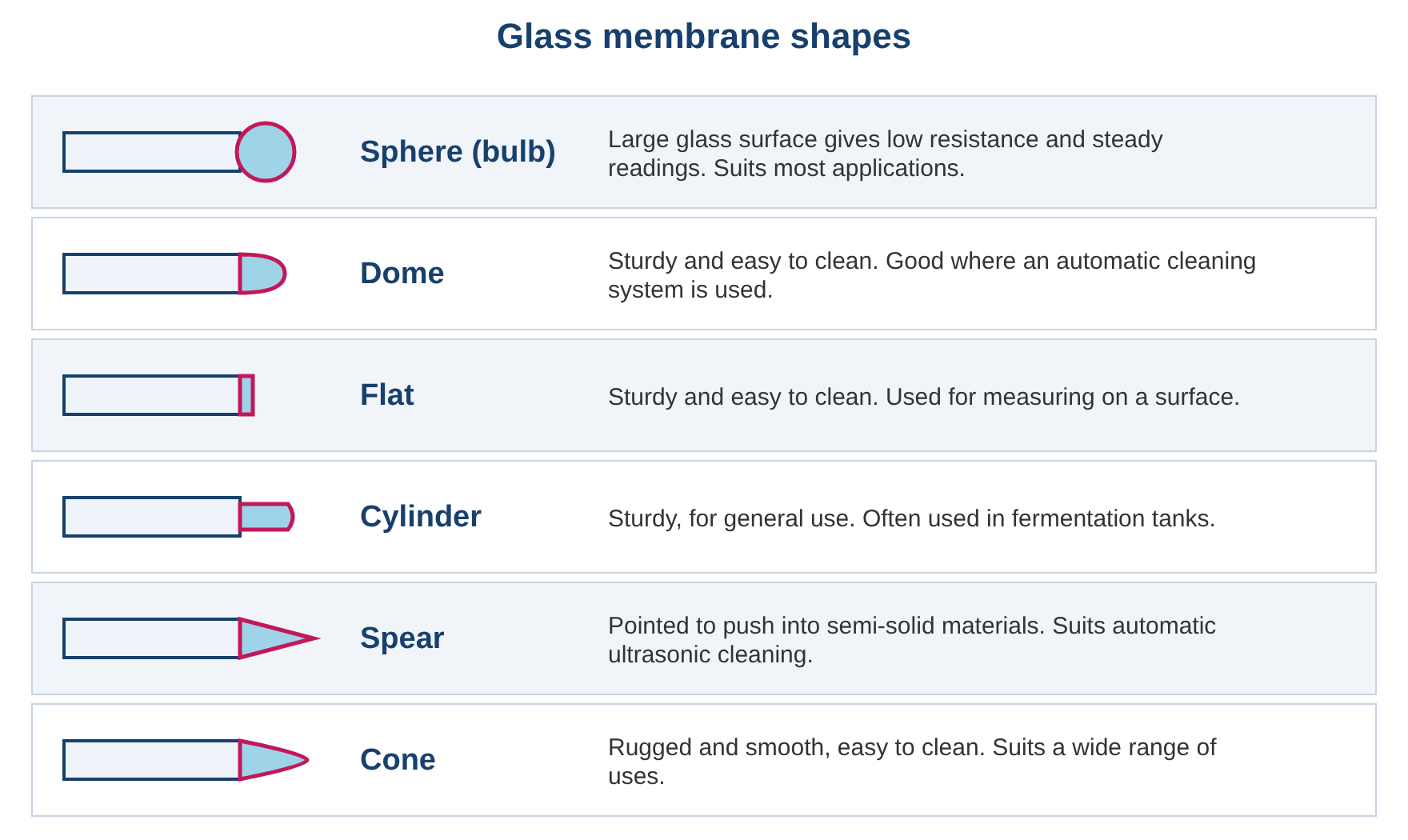
Glass membrane shapes
Sealed or refillable
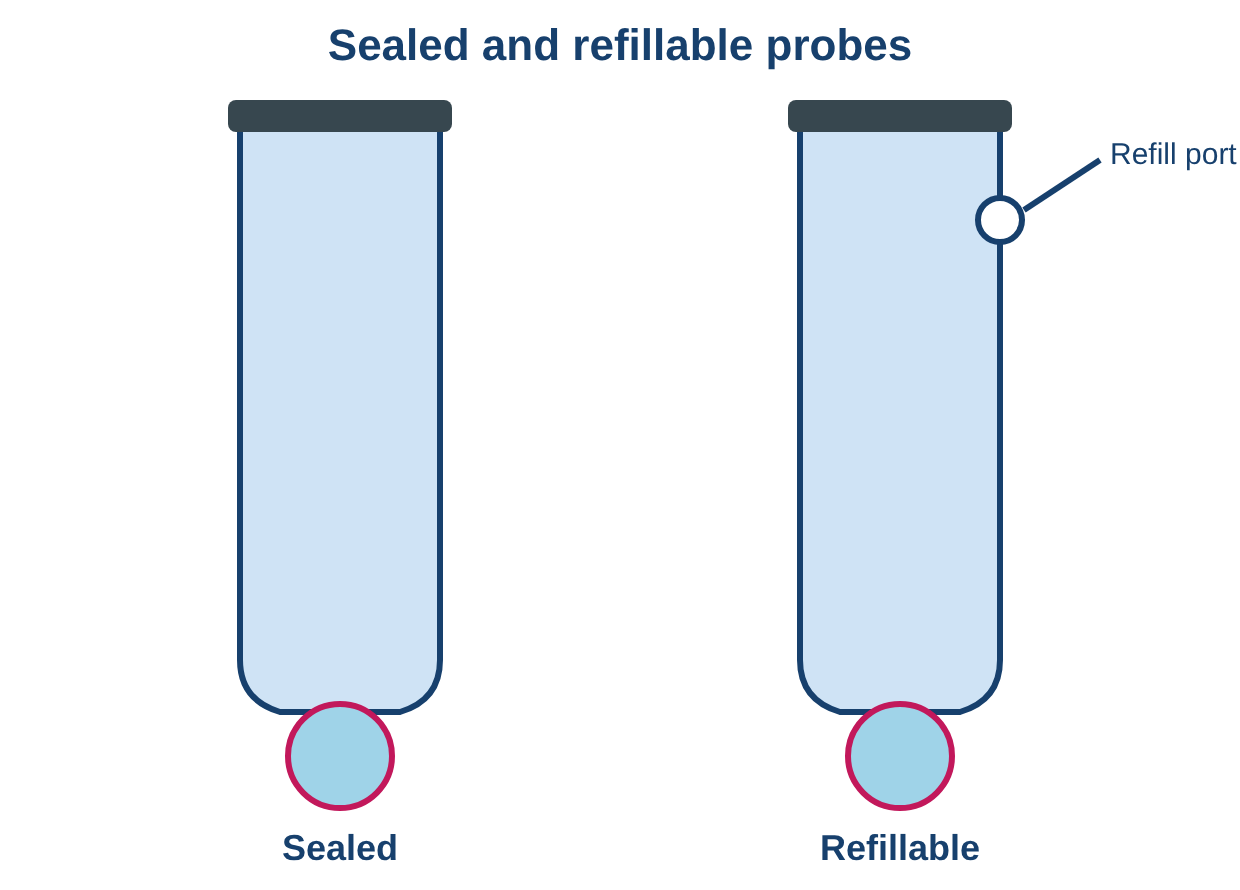
A sealed probe has its KCl reference electrolyte sealed in for life. A refillable probe has a port so the KCl can be topped up.
Cost and life
A higher price doesn't guarantee a longer life, but cost, quality and life are often linked: some materials simply cost more, and cheap materials can mean weaker components. Budget enough for sensor upkeep and replacement.
Calibration buffers and accuracy
When accuracy matters, calibrate with certified buffers traceable to NIST standards, and don't let your buffers become contaminated. Buffers are sold at pH 4.0, 7.0 and 10.0, at 4.005, 7.413 and 10.012, and at other values.
Standard buffer solutions are accurate to better than ±0.005 pH between 0 °C and 60 °C, and to within ±0.008 pH between 60 °C and 95 °C. NIST buffers are used in laboratories and other critical measurements. For industrial use, where absolute accuracy is usually less critical, suppliers offer technical buffer solutions, which may or may not follow NIST standards.
Technical buffers are more stable and easier to make than standard buffers. Their accuracy is usually given as ±0.02 pH, though it varies by supplier, and the effect of temperature is normally printed on the container. Most have a shelf life of about one year sealed and only a few months once opened. Alkaline buffers age fastest, because carbon dioxide from the air contaminates them.
Installing the sensor
Match the sensor to how it will be installed. A probe can hang submerged in an open or closed tank, pit, trench or other holding point, or be mounted inline in a pressurized pipe before or after a tank, pump or other equipment. A submerged probe should sit in a bracket that holds it steady but lets it be lifted out quickly – ideally without tools – for cleaning, inspection and replacement.
- Support the sensor so it can't swing around in the tank and strike the wall or the mixer.
- Place the electrode where the liquid is moving and turbulent. Moving liquid reduces coating and cuts maintenance.
- Keep the electrode away from the chemical injection point, which can bias the reading. Mixing and reaction take time, depending on tank volume and flow.
- Where coating is heavy, consider automatic sensor cleaning – for example a spray head fed with a cleaning liquid that suits the process, often clean water, sometimes a detergent.
pH sensors in aggressive processes
Aggressive and toxic chemicals are hard on sensors. pH and ORP sensors with porous or open reference junctions can fail early when the reference electrode is poisoned. Problem chemicals include cadmium, peroxide, cyanide, ammonia, chlorine, hydrogen sulfide and radioactive materials. They pass through the porous junction and contaminate the Ag/AgCl reference inside, causing poor readings or rapid failure.
The real cost of early sensor failure
When sensors die early, the cost goes well beyond the replacement part. Frequent recalibration and replacement add labor, and used sensors that may be contaminated with harmful materials must be disposed of safely and legally. Careless disposal can damage the environment and expose the company to financial risk.
Longer life: ion traps
Where sulfides or proteins are common, a probe with a built-in ion trap can make a big difference. The ion trap keeps silver ions (Ag+) from reaching the process liquid and forming solid deposits that would plug the porous junction and stop the probe working.
Longer life: non-porous sensors
A non-porous sensor connects the process to the reference electrode through a solid, ionically conductive barrier instead of a porous junction. The barrier keeps the process liquid completely away from the reference electrolyte, so the reference can't be contaminated. That lets non-porous sensors keep working in difficult liquids, including those with toxic chemicals, biological material or radioactive material.
Choosing for aggressive applications
The right sensor cuts maintenance time, improves accuracy and lengthens probe life. In aggressive applications, sensors with ion traps or non-porous junctions generally hold up better than other designs. Still, look at each application on its own: chemical compatibility, the maintenance it will need, and how spent sensors will be disposed of are all part of the choice.
Common electrode problems and fixes
- Oil or solids building up on the electrode, so it needs frequent cleaning and doesn't last: use a non-porous junction sensor, which copes with this much better, and add automatic cleaning to cut maintenance further.
- Broken or failed glass bulbs from abrasive or heavy solids: fit a bulb guard, or mount the probe in a stilling well to slow the flow and protect the glass from impact.
- Fouled or plugged reference junction: use a non-porous junction sensor.
- Short life from reference poisoning (silver in the electrode reacting with the process liquid): use a non-porous junction sensor to remove the risk.
Electrode care and cleaning
Safety first: wear gloves and safety glasses whenever you handle pH electrodes or their solutions.
Keep electrodes wet. An electrode that dries out is ruined. New electrodes usually come with a protective boot or bottle filled with storage solution – leave it on until the electrode goes into service, and keep it for when the electrode is taken out of service. If you have no storage solution, refill the boot with pH 7.0 buffer.
To clean an electrode, follow the sensor maker's instructions for the cleaning solution, strength and soak time. A dilute hydrochloric acid (HCl) soak removes most coatings; other solutions, such as a mild detergent for oily coatings, sometimes work better. Make sure the cleaning solution is compatible with your process. Rinse well with clean water afterward. Never use brushes or abrasive materials – they can damage the measuring surface and ruin the electrode.
Calibration
A glass pH electrode measures relative to its reference, so it must be calibrated regularly to give accurate, repeatable readings. Commercial calibration buffers are standardized against NIST-certified references for meters that read to 0.001 pH.
A one-point calibration usually gives an accurate reading, but regular two-point or three-point calibrations give the most reliable results. Keep buffers on hand for a range of values, for example pH 4, 7 and 10.
On the Intell-i-Watch, a pH probe is calibrated right at the monitor, with on-screen instructions. Up to three buffer solutions can be used, and the Watch stores each calibration value so the probe reads accurately. For other instruments, follow the calibration steps in the instrument's manual.
Conditioning a new electrode
pH electrodes are shipped moist. Before using one for the first time, condition it:
- Remove the protective cap or rubber boot and rinse the electrode with distilled or deionized water.
- Soak the electrode for 20 minutes in one of these liquids (listed from most to least effective): 3.8 M or 4.0 M KCl, pH 4.0 buffer, or pH 7.0 buffer.
- Rinse again with distilled or deionized water. The electrode is ready to calibrate and use.
Never condition an electrode in distilled or deionized water. Long exposure to pure water damages the glass membrane.
Handling
Rinse the electrode with distilled or deionized water between samples.
Storage
Always keep the electrode moist. Store it in 4 M KCl solution; if that isn't available, use pH 4 or pH 7 buffer. Never store it in distilled or deionized water, which draws ions out of the glass bulb and ruins the electrode.
White KCl crystals may form on the outside of a stored electrode. They don't affect readings – rinse the electrode before use.
Most electrodes ship with a rubber boot over the glass to protect it from cracks and scratches. Remove the boot before use. For long-term storage, put the boot back on with enough 4 M KCl inside to cover the glass bulb, and top it up as needed to keep the bulb moist.
Temperature compensation
The pH of a solution depends on its temperature. The electrode's voltage changes in a straight line with pH, and temperature sets the slope of that line. At 25 °C – the standard temperature all calibrations refer to – one pH unit equals 59.16 mV. The slope falls to 54.20 mV per pH unit at 0 °C and rises to 74.04 mV per pH unit at 100 °C.
Because pH depends on temperature, pH measurements need temperature compensation to give standardized values. Instruments with automatic temperature compensation (ATC) take a continuous signal from a temperature sensor and correct the pH reading automatically; manual compensation needs the user to enter the temperature. ATC is the more practical choice for most applications. A temperature sensor can also be connected to the Intell-i-Watch, so temperature is displayed and logged alongside pH.
Additional thoughts
If your pH sensors aren't performing well – frequent failures, too much maintenance or readings you can't trust – it's a good time to review the sensor type and how it is installed and monitored. A sensor that performs better, lasts longer and is easier to dispose of can improve efficiency and help you stay within your discharge limits. Contact us to talk through your application and how the Intell-i-Watch can monitor, log and alarm your pH readings.