Since new, non-contact type level sensing technologies continue developing the older technologies need to be reviewed from time to time to determine their value for continued use. This is true of the ultrasonic sensor as compared to the radar sensors.
Compare Ultrasonic and Radar Level Transmitters
Choosing one measurement technology over another is always a time-consuming matter unless you have similar successful applications repeatedly. Ultrasonic and radar level transmitters need close attention to verify we get the best sensor for the application.
Each technology has a unique set of advantages specific to certain application scenarios. So, we have to ask: What capabilities do the specific applications require and what device makes the most sense from a cost perspective?
Ultrasonic Level Defined
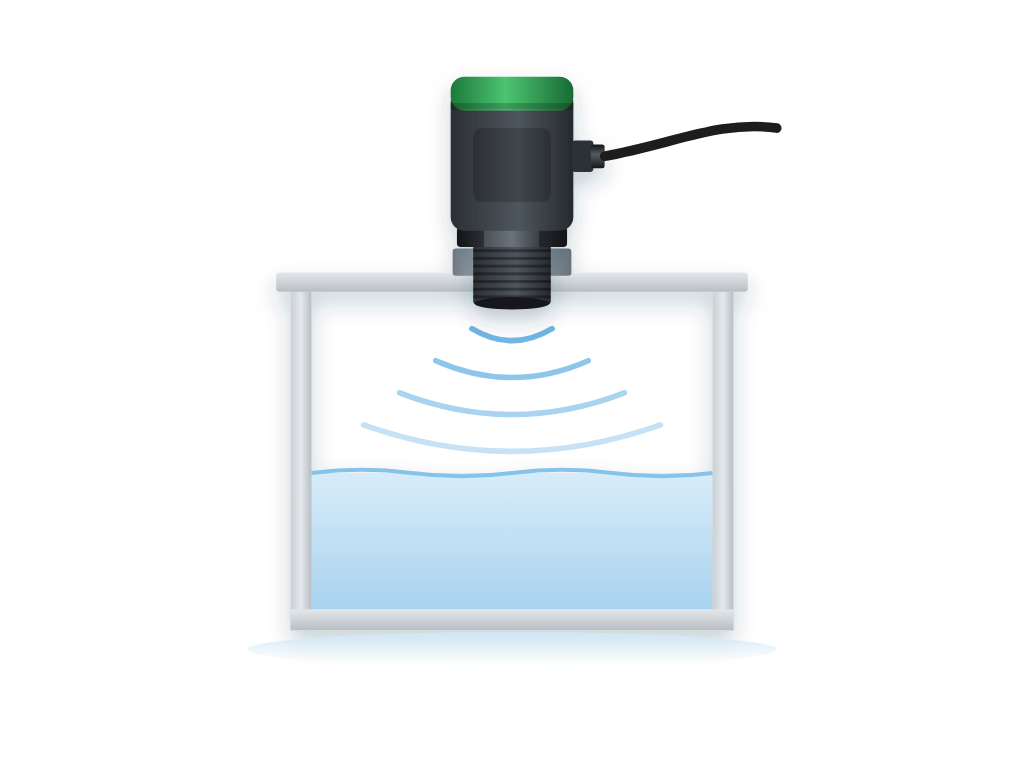
Ultrasonic waves detect an object. Ultrasonic uses ultrasonic sound wave pulse. When an ultrasonic pulse signal is aimed towards an object, it is reflected by the object and echo returns to the sender. The time traveled by the ultrasonic pulse is calculated, and the distance of the object is found.
Advantages: Ultrasonic level transmitters have no moving parts, is non-contact. This typical characteristic of the transmitter is useful for measuring levels in tanks with corrosive, boiling and hazardous chemicals. The accuracy of the reading remains unaffected even after changes in the chemical composition or the dielectric constant of the materials in the process fluids.
- Velocity of sound changes as the air temperature varies. An integrated temperature sensor is used to compensate for changes in velocity of sound due to temperature variations.
- There are some interference echoes developed by the tank edges, welded joints etc. This is alleviated by the sensor software and referred to as interference echo suppression.
- Software setup of the sensor assists in preparation for your conditions prior to operation.
These sensors can be used to produce continuous level measurement and display at an HMI allowing you to provide as many level setpoints (for whatever purposes) as you want along the measurement distance.
The ultrasonic beam typically has a conical shape to some degree. Depending on the tank shape there can be reflection issues based on tank shape and sensor location, so, you do have to study location, placement attitude and tank shape. Sometimes a stilling well pipe is required to allow the beam to return unmolested by turbulence, foam and other conditions. However, the ultrasonic is definitely a tried-and-true device and can be inexpensive, which is great when you have many of them in a process where more features and capability won’t gain much or any advantages.
Limitations: Ultrasonic level transmitters are:
- Tank depth can be an issue where the echo is absorbed or dispersed.
- The measured medium should not be sound absorbing.
- Affected by smoke, high-density moisture or foam.
- Affected by temperature
- Affected by gases
Radar Level Defined
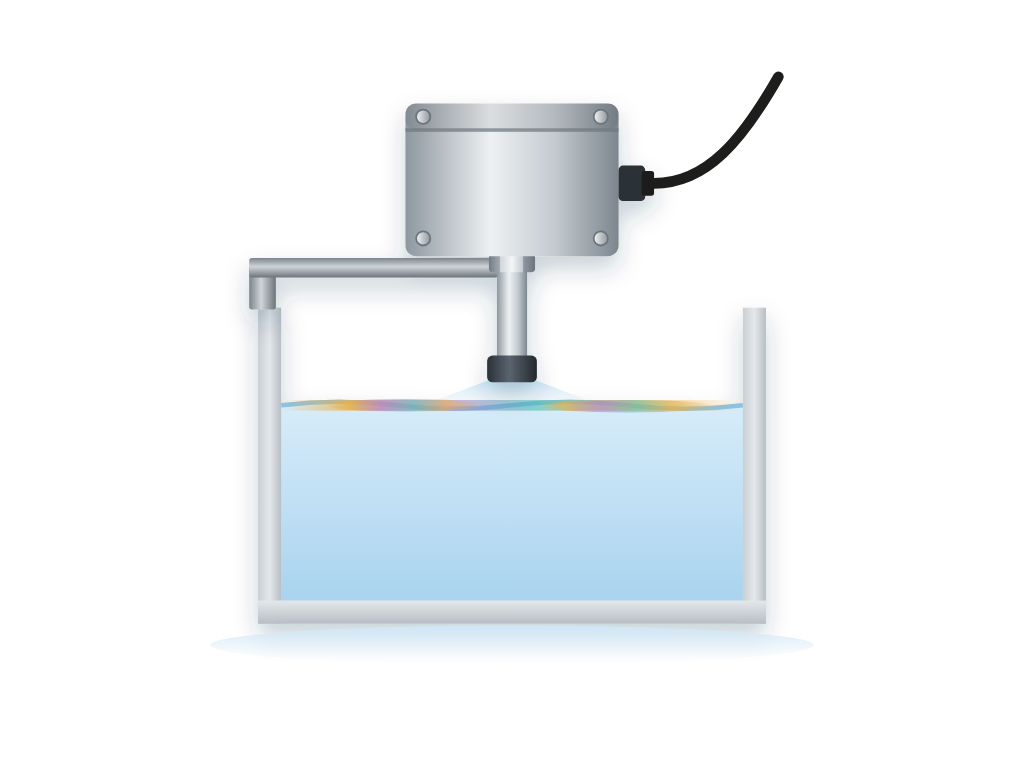
A radar level sensor or transmitter, is a type of sensor used to measure the level of a substance within a container, such as a tank or silo. It utilizes the principles of radar technology by using high frequency radio (microwaves) via free-air transmission to determine the distance between the transmitter and the surface of the material.
Note on guided wave radar: This is a similar technology that uses a cable or rod to guide the radio or microwave to and from the measuring surface as opposed to the free-air transmission of the wave. While this sounds similar to the ultrasonic it is, however, depending on what device you’re using it may be very different in capabilities.
Advantages: They’re accurate, continuous, non-contact, high precision and adaptable to a wide variety of conditions, including severe temperature, pressure and vapors. Unaffected by medium and environment properties such as density, conductivity, filling noise, dust, foam and agitation. Are great for liquids as well as solids. Radar sensors come in a spectrum of price points. As these sensors can offer more features than ultrasonic, they can be reviewed for their particular capabilities based on manufacturer designs and features. Software/app-based configuration makes setup simple and fast.
Layer monitoring
One or more available sensors can detect and measure up to 5 vertical layers and their thicknesses in a tank such as sludge, water phase and oil phase. Once you collect this feedback the Intell-i-Watch system displays each layer on the display providing layer thickness and setpoints, allowing you to trigger alerts, alarms, pump start/stops, historical variation and other automated functions based on those layers and their thicknesses. This type of sensor cost is within the typical ultrasonic sensor cost range and so is quite attractive to implement.
Limitations: Radar level transmitters have few drawbacks as compared to ultrasonic. However, here are a few:
- Can be affected by the dielectric constant of the material be measured
- Rain, snow, high winds can affect wave propagation
- Location: Blocking structures need to be reviewed for wave propagation and return
- Cost: Some sensors may have higher costs than ultrasonic
Maintenance and availability to consider. Devices with no moving parts, such as ultrasonic and radar level sensors are superior to mechanical elements. Ultrasonic and radar sensors share this advantage. The non-contact design provides less wear and tear, with lower maintenance requirements and better device longevity
Additional thoughts
Modern monitoring and control systems are all about efficiency, accuracy, and cost-effectiveness. They are about employing the most suitable technology for the application. Radar level sensors, while advanced and accurate, may not always be the necessary or the most cost-effective choice, depending on the applications. In these situations, ultrasonic level transmitters are still relevant and a good choice. They are reliable, accurate, non-contact, and most importantly, budget-friendly. The relevance of ultrasonic level transmitters remains undisputed in modern control systems.

Intell-i-Watch multi-sensor transmitter monitoring systems are designed and supported by Pan America Environmental, Inc., with over 35 years of experience in industrial water and wastewater treatment.